
Anxiety Related Disorders
Providing compassionate therapy in Ventura County for individuals struggling with anxiety and patterns that feel hard to change.
Healing the Overprotective Mind with Curiosity and Care
Anxiety Disorders
Anxiety can take many forms—racing thoughts, emotional overwhelm, physical symptoms, avoidance, or an inner pressure to get everything “just right.” It can be loud and obvious, or quiet and constant. Many people live with anxiety for years before recognizing it for what it is—something treatable.
Anxiety isn’t weakness. It’s often your body and mind doing their best to protect you—especially if you’ve been through trauma, chronic stress, or emotionally unpredictable environments. Therapy helps you understand what your anxiety is trying to do for you—and teaches your system how to feel safe without staying stuck in survival mode.
Types of Anxiety I Treat:
-
Persistent worry, overthinking, or anticipating worst-case scenarios, often about everyday concerns—like health, relationships, performance, or safety. It may feel like you’re “always on,” never able to relax, even when nothing seems wrong.
-
Fear of judgment or embarrassment can feel overwhelming, leading you to overanalyze past interactions and avoid social situations, even when you crave connection.
-
Persistent worry about physical symptoms or serious illness, despite medical reassurance. This may cause excessive body scanning, compulsive symptom research, or avoiding health information to ease anxiety.
-
Fear of failure and pressure to be perfect often stem from early criticism or conditional praise, leading to low confidence and risk aversion.
-
Sudden, intense episodes of fear often include symptoms like racing heart, dizziness, shortness of breath, and chest tightness. These panic attacks feel terrifying and cause constant worry about when the next one will occur.
-
Intense fear of certain situations or objects—like flying, driving, or enclosed spaces—can cause distress and lead to avoidance, limiting daily life and typical activities.
Obsessive Compulsive Disorder (OCD)
OCD is a distressing cycle of obsessions—unwanted, intrusive thoughts, images, or urges—and compulsions, which are behaviors or mental acts aimed at reducing the intense anxiety those obsessions create. While compulsions may provide momentary relief, they reinforce the brain’s belief that the fear is real, keeping the loop going.
People with OCD often know their thoughts are irrational or excessive—but that insight doesn’t make them stop. OCD isn’t a lack of logic; it’s a nervous system stuck in threat mode, trying desperately to find certainty or safety.
What OCD might sound like:
Intrusive thoughts, fears, images, or urges that feel unwanted and distressing
“What if I accidentally poisoned my family by not washing my hands enough?”
“What if I ran someone over and didn’t notice?”
“What if I secretly want something terrible to happen?”
“What if I touched something contaminated and now I’ll get sick—or make someone else sick?”
“I can’t stop thinking about that image—I must be a horrible person.”
“What if I cheated and don’t remember it?”
“Am I attracted to the wrong person—or the wrong kind of person?”
Obsessions
Compulsions
The actions or mental rituals used to reduce distress or prevent something “bad”
“I’ll wash my hands just one more time to be safe.”
“If I retrace my steps, I’ll know for sure I didn’t hit anyone.”
“I’ll avoid knives or sharp objects—just in case.”
“I’ll reread that message five times to make sure it wasn’t offensive.”
“I have to count to seven in my head so nothing bad happens.”
“I can’t go to sleep until the lights are turned off in a specific order.”
“If I picture the worst-case scenario, I’ll be prepared.”
“I’ll keep mentally reviewing the event until I feel certain.”
Interrupting the Anxiety Cycle
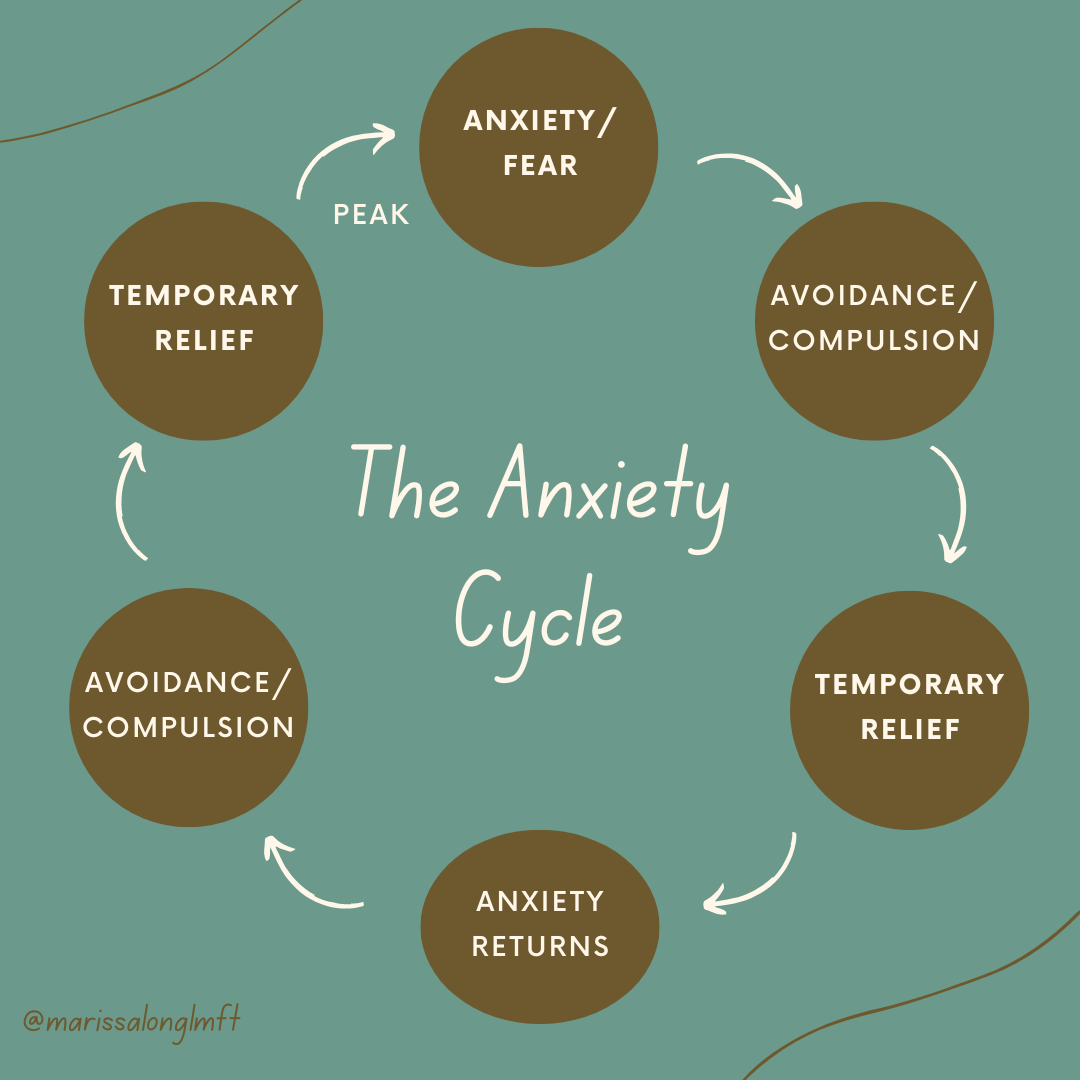
Therapy for anxiety isn’t about getting rid of fear—it’s about learning to trust yourself in the face of it. Together, we’ll help you build the strength and confidence to face what you’ve been avoiding—gently, intentionally, and in a way that reminds you of your own resilience.
Anxiety doesn’t appear out of nowhere. We explore how early environments, attachment, and relational wounds contribute to a hypervigilant nervous system. You may hold beliefs like “I must keep everyone safe,” “Mistakes aren’t allowed,” or “If I let go, everything will fall apart.” Understanding these beliefs in your body and relationships helps us reprocess—not just manage symptoms, but transform their meaning.
The Origins of Overprotection
Anxiety can pull you out of the present and make it hard to feel steady. In therapy, we’ll strengthen your ability to stay grounded by expanding your ‘window of tolerance’—the space where you can feel and respond without becoming overwhelmed. With personalized tools for calming your body, noticing its signals, and naming your emotions, you’ll learn to feel safer, ride out distress, and handle stress without needing to avoid or shut down.
Develop Tools for Regulation & Resilience
Behaviors like over-planning, seeking reassurance, withdrawing, or over-functioning are protective strategies your mind developed to handle uncertainty and stress—not personal flaws. In therapy, we gently explore their origins, how they helped, and why they may no longer serve you. Together, we build your ability to tolerate uncertainty and emotional discomfort without control or avoidance. You’ll learn to stay present and trust yourself even when outcomes aren’t certain. The goal isn’t to eliminate anxiety but to relate to it with flexibility, self-compassion, and less fear. When these protectors soften, you gain freedom to live authentically.
Rewiring Protecting Patterns
Exposure Response Prevention
Exposure Response Prevention [ERP] is a structured, evidence-based approach that helps you gently face the fears, feelings, and situations that fuel anxiety. Instead of relying on avoidance or rituals for short-term relief, you practice responding in new ways—learning that discomfort doesn’t mean danger, and that you can feel safe even without certainty. With time and support, this process rewires the brain’s fear response and helps you build lasting confidence and resilience.